The nominal load is the starting point – critical buckling force, screw speed and mounting type determine the permissible load in the installed configuration.
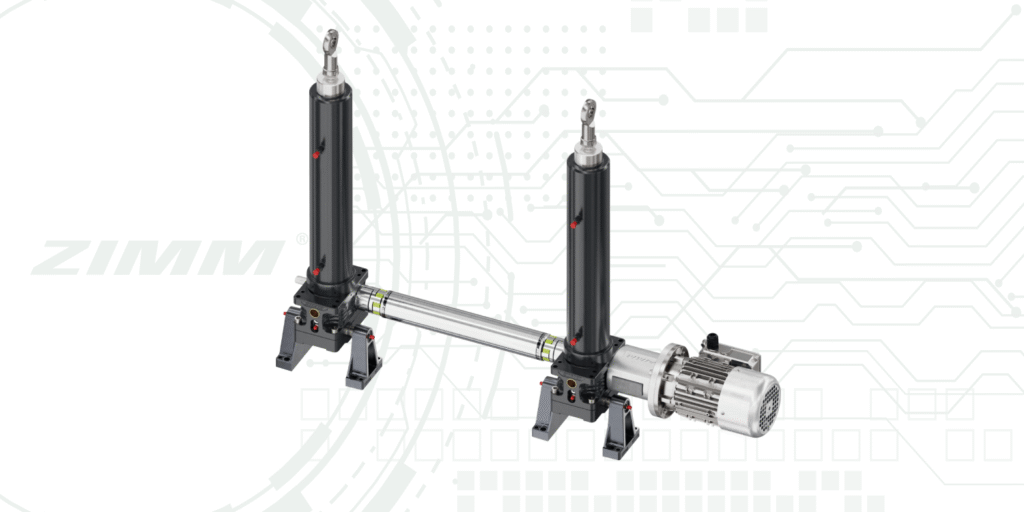
The ZIMM ZA-I inline actuator is available in four sizes: 25, 50, 100 and 200 kN. This nominal load applies as the maximum compression and tension force, both static and dynamic. Whether a specific version may be operated at the full nominal load depends on the stroke, installation position, mounting and movement profile.
Which load cases are distinguished?
Compression and tension forces as well as static and dynamic loads are considered separately. Under compression loading, the critical buckling force limits the permissible axial force: the greater the unsupported length of the extended actuator, the lower the permissible compression load – a guided version permits significantly higher values than an unguided version. With a long stroke and high screw speed, the critical whirling speed additionally limits the permissible speed; it decreases as the system length increases.
What influence does the mounting have?
With fixed mounting, the ZA-I can be subjected to the full static nominal load in compression in all sizes. Under tension loading, the full nominal load acts through the mounting screws of property class 8.8 in the through holes of the housing. With pivoting mounting using pivot mount LB, ZA-I-50, ZAI-100 and ZA-I-200 withstand the full nominal load in compression and tension; for the ZA-I-200, a reduced value applies in the pivoting range between 90° and 45°. For the ZA-I-25, the load at the pivot mount is limited to 19.5 kN in compression, 17.5 kN in tension, 10 kN at 90° and 9.5 kN at 45°.
Which additional limits must be checked?
For complete designing, the stroke and effective working stroke, installation position, type of guidance, screw drive, lifting speed and duty cycle are required. As speed and duty cycle increase, the thermally
permissible load decreases – significantly more with trapezoidal screw drives than with ball screw drives. The load rating alone determines neither the maximum permissible length nor an arbitrary combination of speed and load.
How is the required drive torque taken into account?
The drive torque is determined by the lifting load, screw lead, gear ratio of the drive unit and the efficiencies of the drive unit (DA 1.00, P1 0.98, P2 0.95) and screw (ball screw drive 0.9, single-start trapezoidal screw 0.32–0.39). A safety factor of 1.3 to 1.5 is applied to the motor power calculated from these values; up to 2 for small sizes, low speeds and low temperatures. At low dynamic loads, at least 15% of the nominal load must be used for the calculation – at least 7.5 kN for the ZA-I-50 – because no-load losses have a greater proportional effect.