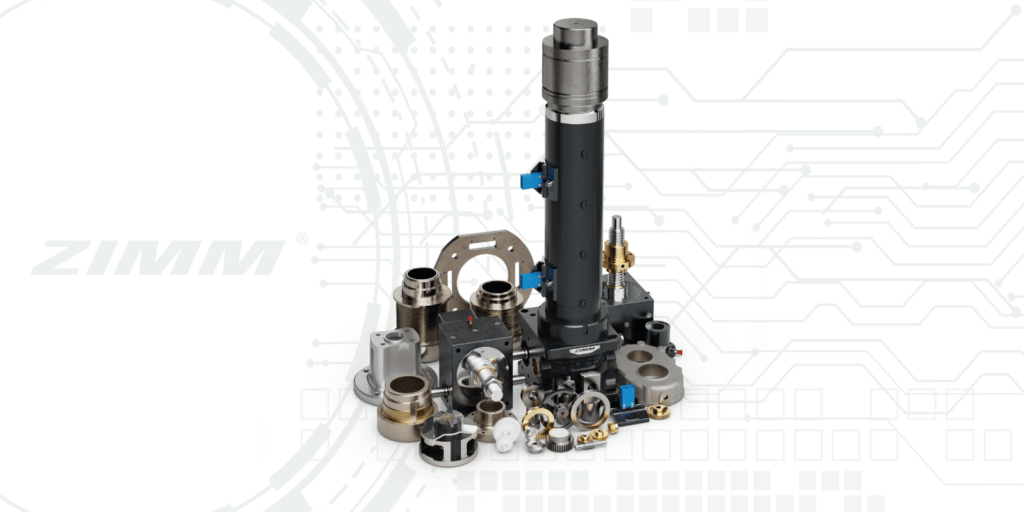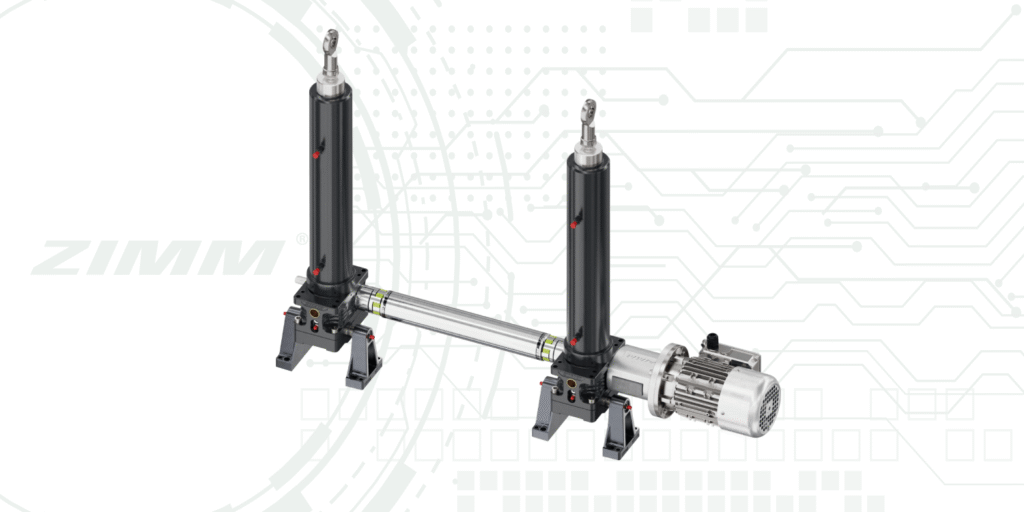
The ZIMM ZA-I inline actuator is available with a trapezoidal screw drive (Tr) or ball screw drive (KGT). Both screw drives convert rotary motion into linear lifting movement, but operate according to different friction principles.
What is the technical difference?
With the trapezoidal screw, the thread flanks of the screw and nut slide against each other. With the ball screw drive, balls roll between the screw and nut. This results in differences particularly in friction losses and load-holding behaviour.
| Criterion | Trapezoidal screw drive (Tr) | Ball screw drive (KGT) |
| Operating principle | Sliding friction | Rolling friction |
| Screw efficiency in the design data | Single-pitch 0,32–0,39; double-pitch 0,48–0,56 (μ = 0,11) | 0,90 |
| Self-locking | Dependent on screw version and operating conditions | Not self-locking |
| Motor brake | Required for double-pitch screws | Required |
| Motor connection | Standard coupling KUZ | Clamp coupling KUZ-KK |
Which screw drives are available for each size?
The available screw diameters and pitches differ depending on the size: ZA-I-25, for example, with Tr 30×6 or KGT 32×10, ZA-I-50 with Tr 40×7 or KGT 40×20, ZA-I-100 with Tr 55×9 or KGT 50×20 and ZAI-200 with Tr 70×12 or KGT 80×20. Further variants are available for the respective sizes.
Which information determines the screw drive selection?
The required information includes lifting load, stroke, speed, movement cycle, duty cycle and requirements for holding the load. The screw lead is considered together with the drive variant DA, P1 or P2 and the input speed.