A clear answer to a critical question: No – and here you will learn why and how to design your system correctly.
The clear answer is: no. Screw jacks and their core components – lifting screw and nut – are designed exclusively for transmitting purely axial forces (compressive and tensile forces in the direction of the screw axis). Taking up side loads – also referred to as lateral or radial forces – leads to impermissible loading, massively increased wear and can very quickly result in failure of the entire drive. A screw jack must therefore never be misused as a guiding element for the load.
Why are side loads so harmful?
When side loads act on the screw or travelling nut, several critical effects occur simultaneously:
- Tilting of the nut: The nut tilts in the housing or on the screw. The thread flanks no longer carry over the full surface, but only along lines or at points on the edges.
- Increased surface pressure: The load is concentrated on a very small contact area. The local surface pressure rises sharply and can overload the material.
- Disruption of the lubricant film: The lubricant film is torn at the edges. Direct metal-to-metal contact (galling/seizing) and abrasive wear occur.
- Overloading of the bearings: The side load is transmitted into the bearings of the screw and worm wheel, which are not designed for this. Bearings and housing seats wear or are damaged.
- Bending of the screw: The screw is bent, which increases the risk of buckling and leads to irregular running, vibration and additional wear.
The result: Greatly accelerated wear of nut and screw thread, increased bearing load and a drastic reduction in service life – often to only a fraction of the theoretically expected values.
The correct design solution: External guides
To keep side loads safely away from screw jacks, the moving load must always be guided by a separate linear guiding system that is designed for these forces.
- Typical solutions:
- Profile rail guides: Very high stiffness and precision, able to absorb high forces and moments in all directions – ideal for demanding mechanical engineering applications.
- Shaft guides with linear ball bearings: An economical solution for low to medium loads and medium accuracy requirements.
- Slide guides: A robust option for dirty or harsh environments where recirculating-ball systems reach their limits.
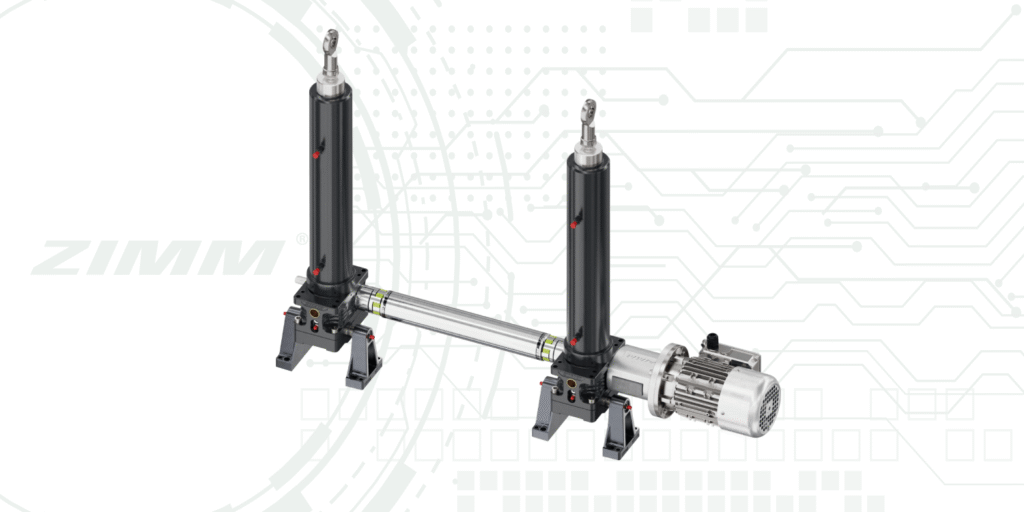
The screw jack is then connected to the guided load in such a way (e.g. via a joint or a push rod) that it only introduces the axial pushing or pulling force. All side loads and moments are absorbed by the guides.
This clear separation of functions – guiding on the one hand and driving via the screw jack on the other – is the basic principle for durable, safe-to-operate and predictable linear motion systems.