Your enquiry list is currently empty!

Your enquiry is our drive
Your enquiry is our drive

Despite our comprehensive wiki, you haven’t found the information you’re looking for? Then don’t hesitate to contact us directly.
Our team will be happy to help you personally – whether it’s specific applications, custom-made products or missing content. Together we will find the right solution.
Author:
Last modified:
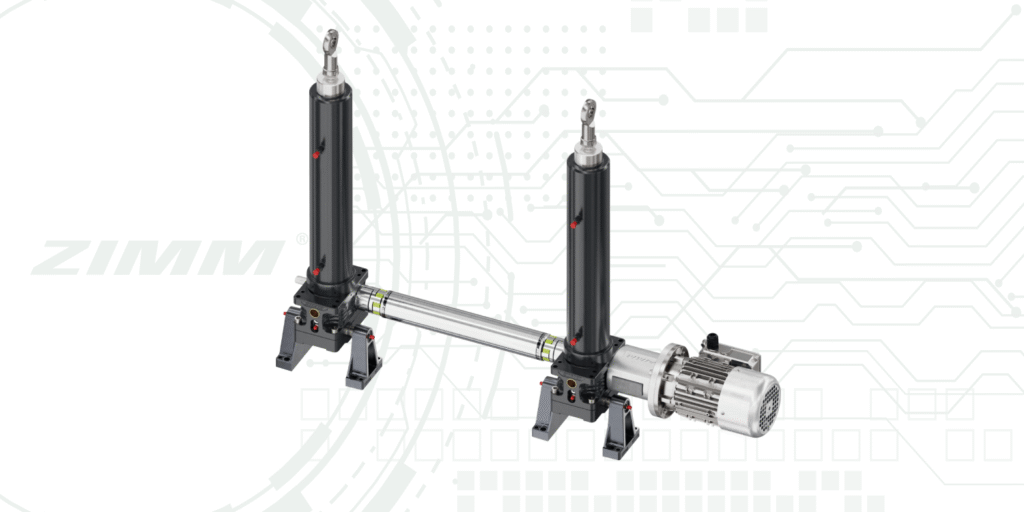
Self-locking describes the ability of a screw drive to safely hold an axial load without any external braking force – even when the drive is switched off. The holding effect is created purely mechanically by the friction in the thread flanks. This is a key safety feature in particular for trapezoidal screw drives (TR) to prevent uncontrolled lowering in the event of a power failure or system shutdown. In applications with ball screw drives (KGT), there is fundamentally no self-locking due to the very low friction – here a motor brake is required.
Self-locking occurs when the friction-based holding forces in the thread are greater than the driving force component resulting from the load acting via the inclined plane of the thread flank. The decisive parameter is the lead angle of the screw:
(Note: The effective self-locking capability additionally depends on the coefficient of friction, lubrication, temperature and surface condition.)
At lead angles > approx. 4.5°, self-locking is generally no longer present. KGT, due to rolling friction, are in principle not self-locking and always require an external brake for load-holding.
Self-locking is crucial whenever unintentional lowering could endanger people, machinery or product. Typical use cases:
Note: Vibrations or shocks can impair static self-locking. In highly critical or dynamically loaded applications, it is common practice to provide a motor brake and/or safety components (e.g. safety nut, limit switches/encoders) in addition to (possible) self-locking for redundancy. Expert design of the safety concept is part of system planning.
Best practice: Precise alignment, correct assembly sequence, suitable lubrication → increases service life and safety margin.


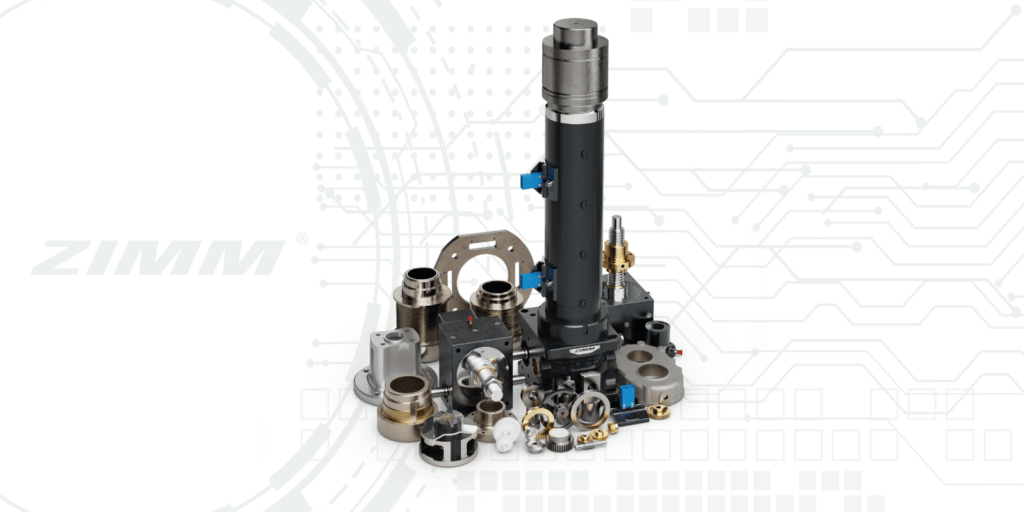
Our expertise ranges from the development and manufacture of industrial gearboxes with matching parts to casting, series production and precision machining. We not only offer robust gearboxes, but also customized drive elements, manufactured exactly according to your drawings and specifications.
As Europe’s leading manufacturer of screw jacks, we rely on state-of-the-art machinery and extensive measuring and testing facilities. This enables us to manufacture almost all products ourselves and deliver top quality at all times.
Regardless of the application or industry – our solutions are perfectly tailored to your needs. Make your inquiry today and boost your production processes with our flexible and customizable solutions.
Please contact our representative using the form. We will get back to you promptly with the appropriate answer.

You need to load content from reCAPTCHA to submit the form. Please note that doing so will share data with third-party providers.
More Information