Your basket is currently empty!

Your enquiry is our drive
Your enquiry is our drive

Despite our comprehensive wiki, you haven’t found the information you’re looking for? Then don’t hesitate to contact us directly.
Our team will be happy to help you personally – whether it’s specific applications, custom-made products or missing content. Together we will find the right solution.
Author:
Last modified:
A screw jack is an electromechanical drive that converts rotary motion (rotation) into linear motion (translation). Its main task is to lift, lower, move, or position loads with precision. It is more than just a simple actuator: as an integrated system for precise and safe power transmission, its design enables high force amplification and reproducible positioning accuracy.
ZIMM offers proven solutions for this in various series and sizes – including the S version (translating spindle) and R version (rotating spindle with travelling nut) – covering a wide range of loads.
The heart of a screw jack consists of a few robust components housed in a gearbox:
It protects the internal components, provides mounting, and supports heat dissipation. Depending on the series, ZIMM uses classical designs derived from worm gear units as well as flexibly mountable, cubic housings; they are designed for high power density, smooth running, and durable corrosion protection.
It is driven by a motor (e.g. servo or asynchronous motor) and transmits the rotary motion to the worm wheel.
This gear is driven by the worm shaft. It has an internal thread and acts as a precisely guided nut for the screw – the basis for friction-locked, backlash-free conversion to linear motion.
It generates the actual linear motion. Depending on the requirements, trapezoidal screw drives (robust, self-locking) or ball screw drives (high efficiency, low friction) are used – for precise control, repeat accuracy, and high efficiencies.

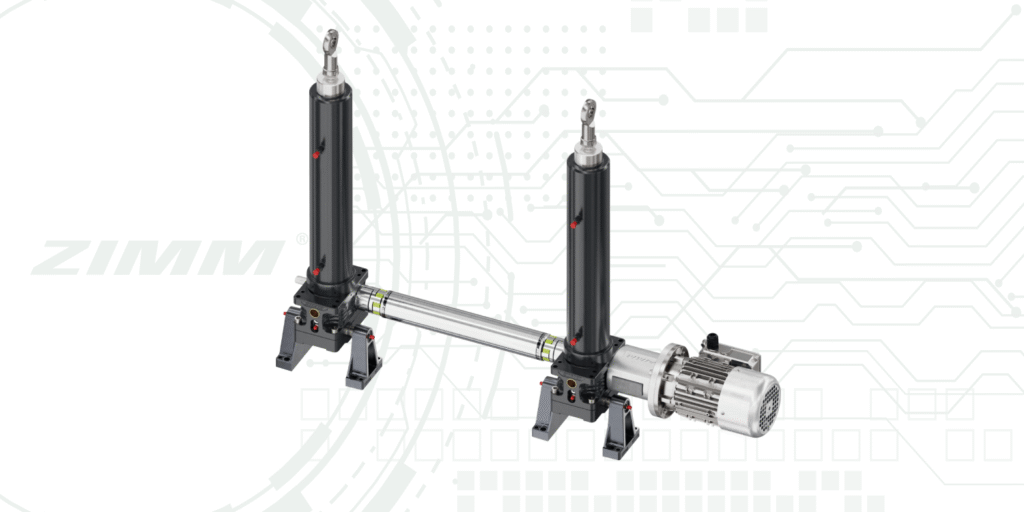
The function of a screw jack is based on the principle of a worm gear, which achieves a high gear reduction in a compact installation space. This design is a key feature for force amplification: a small, cost-efficient standard motor can thus move large loads precisely – lifting, lowering, or positioning them. In ZIMM terminology, two main variants are distinguished, both of which convert the motor’s rotary motion into linear lifting motion.
The motor drives the worm shaft, which in turn moves the worm wheel in the housing. The lifting screw is prevented from rotating (e.g. by the connected load) and moves axially up or down through the rotating internal thread of the worm wheel – the screw extends from and retracts into the gearbox. This version is robust, self-locking (with trapezoidal screw), and the first choice for many adjustment tasks.
Here the lifting screw is connected to the worm wheel and rotates with it. The linear motion is provided by an external travelling nut that runs along the screw thread while the screw itself maintains its axial position. This variant enables high lifting speeds and efficiency – especially in combination with ball screw drives – and can be integrated into systems in a modular way.
This mechanical conversion and amplification makes screw jacks a reliable, precise, and economical solution for a wide range of industrial applications where controlled force and exact positioning are required. ZIMM supplements this with suitable safety and system components (e.g. safety nut, accessories from the ZIMM modular system), so that complete, scalable lifting systems can be implemented quickly.

Category:
Questions and answers about our products
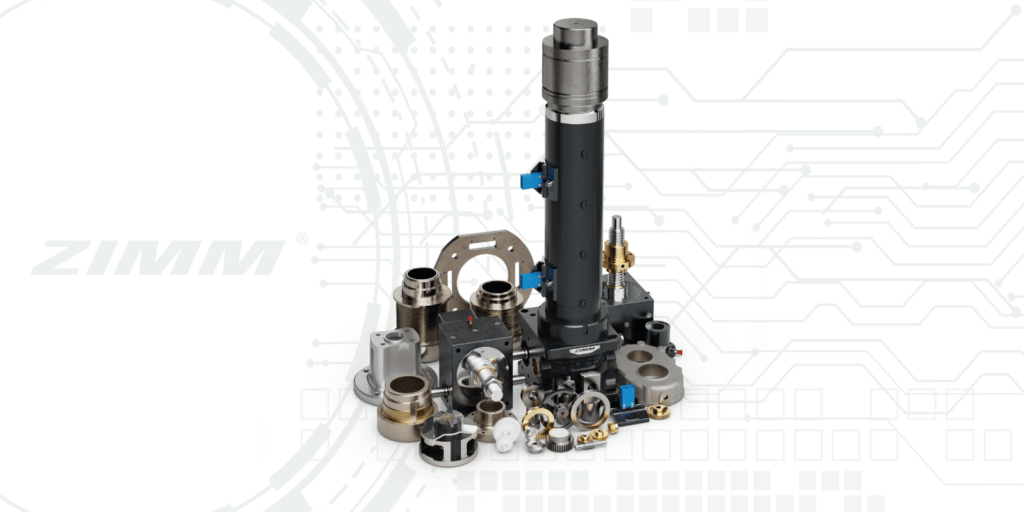
Our expertise ranges from the development and manufacture of industrial gearboxes with matching parts to casting, series production and precision machining. We not only offer robust gearboxes, but also customized drive elements, manufactured exactly according to your drawings and specifications.
As Europe’s leading manufacturer of screw jacks, we rely on state-of-the-art machinery and extensive measuring and testing facilities. This enables us to manufacture almost all products ourselves and deliver top quality at all times.
Regardless of the application or industry – our solutions are perfectly tailored to your needs. Make your inquiry today and boost your production processes with our flexible and customizable solutions.
Please contact our representative using the form. We will get back to you promptly with the appropriate answer.

You need to load content from reCAPTCHA to submit the form. Please note that doing so will share data with third-party providers.
More Information