Your enquiry list is currently empty!

Your enquiry is our drive
Your enquiry is our drive

Despite our comprehensive wiki, you haven’t found the information you’re looking for? Then don’t hesitate to contact us directly.
Our team will be happy to help you personally – whether it’s specific applications, custom-made products or missing content. Together we will find the right solution.
Author:
Last modified:
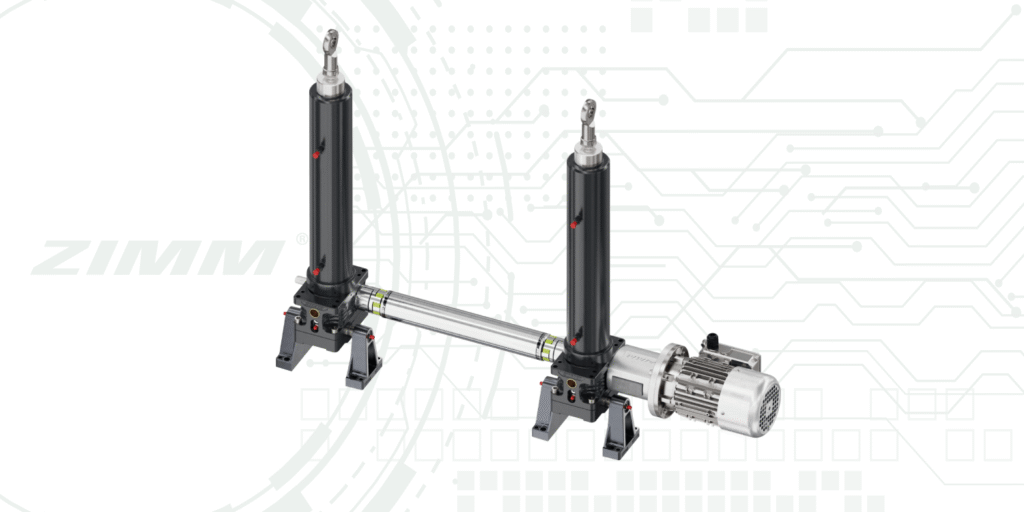
When designing screw jacks, especially for applications with long strokes, the load capacity of the gearbox and the motor power alone are not sufficient. Two additional physical limits of the screw itself must always be checked: the critical buckling load under compressive loading and the critical speed for rotating screws. Ignoring these limits can lead to deflection, vibrations and, in the worst case, failure of the system.
A long, slender screw subjected to high compressive force behaves like a column and can suddenly buckle sideways – long before the material itself would be overloaded. This effect is called buckling. The maximum compressive force a screw can withstand without buckling is the critical buckling load.
Always when the screw is predominantly loaded in compression. For pure tensile loading there is no danger of buckling.
The buckling load is calculated using the Euler or Tetmajer formulas. It essentially depends on the following factors:
The operating force should be at most about 80% of the permissible axial force, and the buckling safety factor (ratio of critical buckling load to operating load) should typically be between 3 and 6. Since the calculation is complex, technical manuals and catalogues usually provide diagrams from which the permissible compressive force can be read directly as a function of the free screw length.
A long, rotating screw (e.g. in travelling-nut versions) can enter into resonant vibration at a certain speed. The screw begins to deflect significantly and to “whip”. This speed is called the critical speed and must be avoided under all circumstances.
Always for versions in which the screw rotates – in particular for travelling-nut designs and long lifting screws with higher speeds.
The critical speed depends on the same factors as the buckling load:
If the check shows that one of the limits is exceeded, design modifications must be made – such as choosing a screw with a larger diameter, changing the support conditions, adding intermediate supports or reducing the speed (e.g. via the screw lead). This keeps the system with screw jacks safe, stable and reliable across the entire operating range.


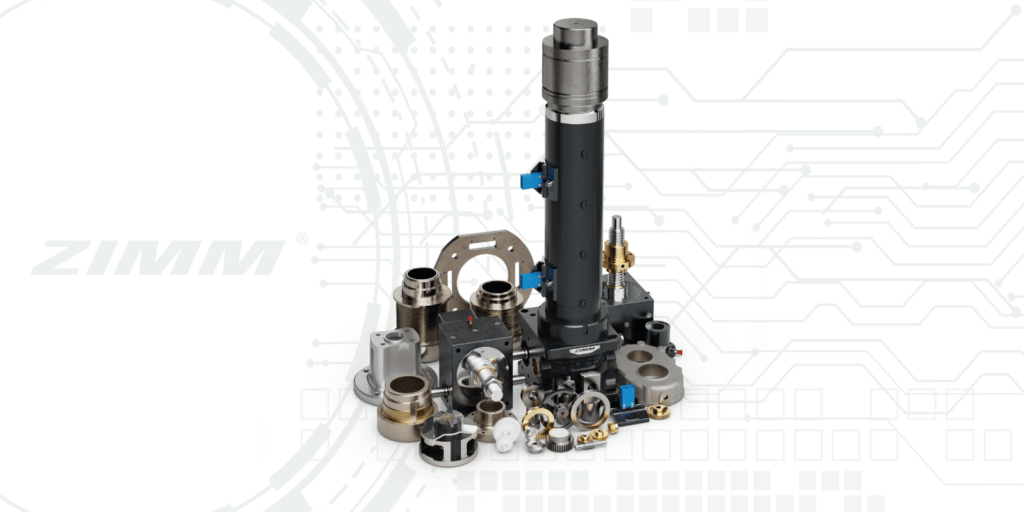
Our expertise ranges from the development and manufacture of industrial gearboxes with matching parts to casting, series production and precision machining. We not only offer robust gearboxes, but also customized drive elements, manufactured exactly according to your drawings and specifications.
As Europe’s leading manufacturer of screw jacks, we rely on state-of-the-art machinery and extensive measuring and testing facilities. This enables us to manufacture almost all products ourselves and deliver top quality at all times.
Regardless of the application or industry – our solutions are perfectly tailored to your needs. Make your inquiry today and boost your production processes with our flexible and customizable solutions.
Please contact our representative using the form. We will get back to you promptly with the appropriate answer.

You need to load content from reCAPTCHA to submit the form. Please note that doing so will share data with third-party providers.
More Information