

YOUR REQUIREMENTS – OUR SOLUTIONS
ZIMM drive solutions for railway technology | Lifting, tilting and positioning
| Movement tasks: | Lifting · Tilting · Positioning · Clamping and releasing · Opening and closing |
| Product groups: | Screw jacks · Electromechanical actuators |
| Lifting force ranges: | Screw jacks: 2.5 to 1,000 kN per jack · Electromechanical actuators: 25 to 200 kN |
| Application examples: | Wheelset changing systems · Turnout transport wagons · Mobile workshops |
| Areas of use: | Rail vehicles · Railway workshops · Track worksites · Maintenance vehicles |
| Project types: | New OEM design · Retrofit |
During the servicing, transport and maintenance of rail vehicles and rail infrastructure, heavy loads have to be lifted, tilted, positioned, clamped and released in a controlled manner. ZIMM screw jacks and electromechanical actuators generate the linear movements required for this – in wheelset changing systems, on turnout transport wagons and in mobile workshops, among other applications.
Within the ZIMM modular system, screw jacks and electromechanical actuators can be combined with matching screws, motors, connecting shafts, couplings and add-on parts. This creates coordinated drive systems for a wide range of vehicle, workshop and transport applications. The sizing depends on the lifting force, stroke, speed, duty cycle, number of drive points, installation situation, ambient conditions and the safety concept of the overall system.
ZIMM GmbH develops and manufactures screw jacks, bevel gearboxes, electromechanical actuators and matching add-on parts for industrial lifting, positioning and drive tasks at Millenniumpark 3, 6890 Lustenau, Austria.
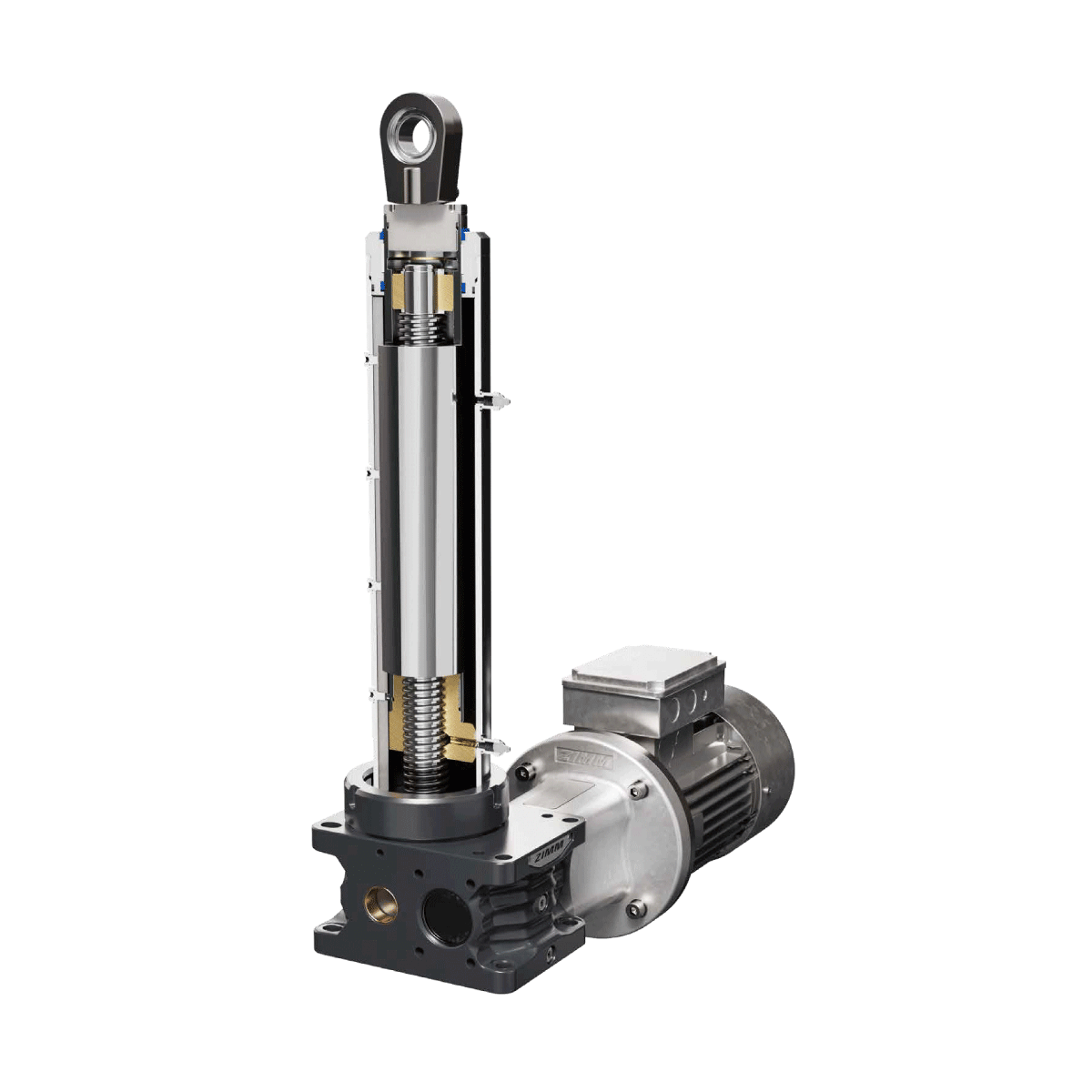
Electromechanical actuators
ZIMM electromechanical actuators generate controlled linear movements for lifting, lowering, supporting, positioning and adjusting components or loads. Depending on the version and the system design, they are available for lifting forces from 25 to 200 kN.
The screw enclosed in the housing and the sealed gear support use in demanding environments. Degree of protection, corrosion protection, temperature range, lubrication and sealing design are defined according to the actual operating and ambient conditions. Matching flanges, rod ends, support plates, bearings, limit switches and further add-on parts support both mechanical integration and integration into the control system.
Several actuators can be moved together in two ways. A mechanical coupling via connecting shafts enforces the same stroke at all coupled drive points, provided the ratio and the screw lead are identical; the synchronisation is therefore defined kinematically and does not depend on the control system. Where drive points are driven separately, different strokes are possible; in this case the synchronisation is established by the control system and position sensors and has to be monitored. Both variants can be combined within one installation.
Extract from our industry expertise
Wheelset change on rail vehicles | Railcar example
In a wheelset changing system for railcars, the vehicle is raised in a controlled manner and secured in a defined working position. A two-part fork design separates the vehicle lift from the handling of the wheelset. The operation is also referred to as an axle change or axle replacement. One fork tine lifts the railcar. The second fork tine takes up the wheelset to be removed, lowers it and then positions the new wheelset at the required installation height. ZIMM screw jacks generate the linear movements within the lifting and handling device. The series, number and arrangement of the jacks are defined according to the vehicle mass, load distribution, stroke and the design concept of the system. The underlying functional principle can also be designed on a project-specific basis for further types of rail vehicle. Direct transfer to other vehicles does, however, require technical adaptation to the lifting points, wheelset geometry, load distribution, workshop layout and safety concept.
Benefits
- Vehicle lifting and wheelset handling in a single device – no separate handling unit and no repositioning of the vehicle required
- The wheelset is handled while the vehicle remains secured in the working position – the workshop road is occupied for less time
- Reproducible lifting and transfer positions support the workflow
- Several lifting points can be mechanically coupled or synchronised via the control system
- The functional principle can be adapted to different rail vehicles on a project-specific basis
Operating principle
- A motor introduces the rotary motion into the screw jack system
- The screw jacks convert the rotary motion into linear lifting movements
- The first fork tine lifts the vehicle and positions it at working height
- The second fork tine lowers the old wheelset and positions the new wheelset
- Separate load-bearing, guiding and safety elements absorb lateral forces and secure the workflow
Application scenarios
- Wheelset changes on railcars
- Project-specific wheelset changing systems for further rail vehicles
- Stationary lifting and handling devices in railway workshops
- New OEM design of workshop and maintenance systems
- Technically suitable retrofit projects on existing lifting systems
In a wheelset changing system for railcars, a two-part fork design separates the vehicle lift from the handling of the wheelset. One fork tine lifts the vehicle and secures it in the working position, the second lowers the old wheelset and positions the new one at the installation height. ZIMM screw jacks generate the linear movements within the lifting and handling device.
Turnout transport wagons | Tilting, securing and delivering turnouts just in time
Turnout transport wagons take fully assembled turnouts directly from the assembly plant to the track worksite. The turnout is completely assembled at the plant, transported to the worksite in a tilted position and installed there immediately. The removed turnout is returned in the same cycle for refurbishment or recycling. So that large turnouts also remain within the prescribed loading gauge during transport, they are tilted on the wagon. The decisive factor is the permissible rolling stock gauge in accordance with EN 15273-2. Before unloading, the turnout is moved into the horizontal position in a controlled manner. The application comprises two separate drive functions:
- Electromechanical actuators handle the tilting and positioning of the turnout
- Screw jacks actuate the mechanical clamping system for securing and releasing the turnout components
The clamping system can be designed for different turnout constructions with concrete, timber or steel sleepers, as well as for versions with or without a fitted point machine.
Benefits
- Large pre-assembled turnouts remain within the loading gauge during transport
- The fully assembled turnout is unloaded and installed immediately – even short track possessions can be used
- Turnout components can be secured and released quickly
- No pre-assembly area required at the worksite – a prerequisite for turnout renewals where no space is available near the worksite
- Removed turnouts can be returned within the same transport process
Operating principle
- Electromechanical actuators generate the linear adjusting movement of the tilting mechanism
- The tilting mechanism brings the turnout into the required transport position
- Before unloading, the turnout is returned to the horizontal position
- Independently of this, screw jacks actuate the mechanical clamping system
- The control system, sensors and mechanical securing devices coordinate and monitor the movement sequences
Application scenarios
- Just-in-time delivery of fully assembled turnouts
- Transport of large turnouts within the prescribed loading gauge
- Turnout renewals without a pre-assembly area near the worksite
- Track worksites in conurbations and areas with limited space
- Return transport of removed turnouts for refurbishment or recycling
Turnout transport wagons take fully assembled turnouts directly from the assembly plant to the track worksite, where they are installed immediately; the removed turnout is returned in the same cycle for refurbishment or recycling. The application comprises two separate drive functions: ZIMM electromechanical actuators handle the tilting and positioning of the turnout, ZIMM screw jacks actuate the mechanical clamping system for securing and releasing the turnout components.
Mobile workshop | Opening and closing access flaps in a controlled manner
Mobile workshops bring personnel, tools and equipment directly to rail infrastructure worksites. Access flaps have to open and close reliably to provide controlled access to working, tool or transport areas. ZIMM electromechanical actuators generate the linear adjusting movement required for this. They can be integrated mechanically into the flap structure and into the vehicle control system. The actuator performs the opening and closing movement. Guidance, locking, sensors and the safety concept of the flap are designed as separate elements of the overall system.
Benefits
- Controlled opening and closing movement of the access flap
- Reproducible and monitorable flap positions
- Direct integration into electrical vehicle control systems
- No hydraulic fluid within the ZIMM drive axis
- Adaptation to flap geometry, installation space and ambient conditions
Operating principle
- An electric motor drives the gearing and the screw drive of the actuator
- The screw drive converts the rotary motion into a linear movement
- The actuator moves the flap via the designated connection points
- Limit switches or position sensors report the flap position to the vehicle control system
- Separate guiding and locking elements secure the flap within the overall system
Application scenarios
- Access flaps on mobile workshops
- Maintenance and engineering train vehicles
- Tool and material flaps
- Access flaps on working and service modules
- Retrofit of existing hydraulic or pneumatic flap drives
Mobile workshops bring personnel, tools and equipment directly to rail infrastructure worksites. Access flaps have to open and close reliably to provide controlled access to working, tool and transport areas. ZIMM electromechanical actuators generate the linear adjusting movement required for this and can be integrated both mechanically and into the control system of the vehicle.
Frequently asked questions about ZIMM drive technology for railway applications
Send your enquiry about your railway application now
Are you planning a lifting, tilting, positioning, clamping or flap function for a rail vehicle, a turnout transport wagon or a mobile workshop? Send us the movement task and the technical details listed in the frequently asked questions. A drawing or sketch of the installation situation can be attached directly. ZIMM supports you in selecting and sizing screw jacks or electromechanical actuators.