
YOUR REQUIREMENTS – OUR SOLUTIONS
ZIMM drive technology for ground support equipment | Lifting, adjusting and driving
| Movement tasks: | Lifting · Supporting · Levelling · Erecting · Adjusting · Driving |
| Product groups: | Screw jacks · Electromechanical actuators · ZK Bevel gearboxes |
| Lifting force ranges: | Screw jacks: 2.5 to 1,000 kN per gearbox · Electromechanical actuators: 25 to 200 kN |
| Output torques: | ZK Bevel gearboxes: 18 to 200 Nm · Ratios 1:1, 2:1 and 3:1 |
| Application examples: | Passenger steps · Loader · Transporter |
| Areas of use: | Airport apron · Passenger handling · Cargo and baggage handling · Air cargo terminal · Aircraft maintenance in the hangar |
| Quality management: | ISO 9001:2015 · Requirements from ISO, EN, SAE and IATA standards on a project-specific basis |
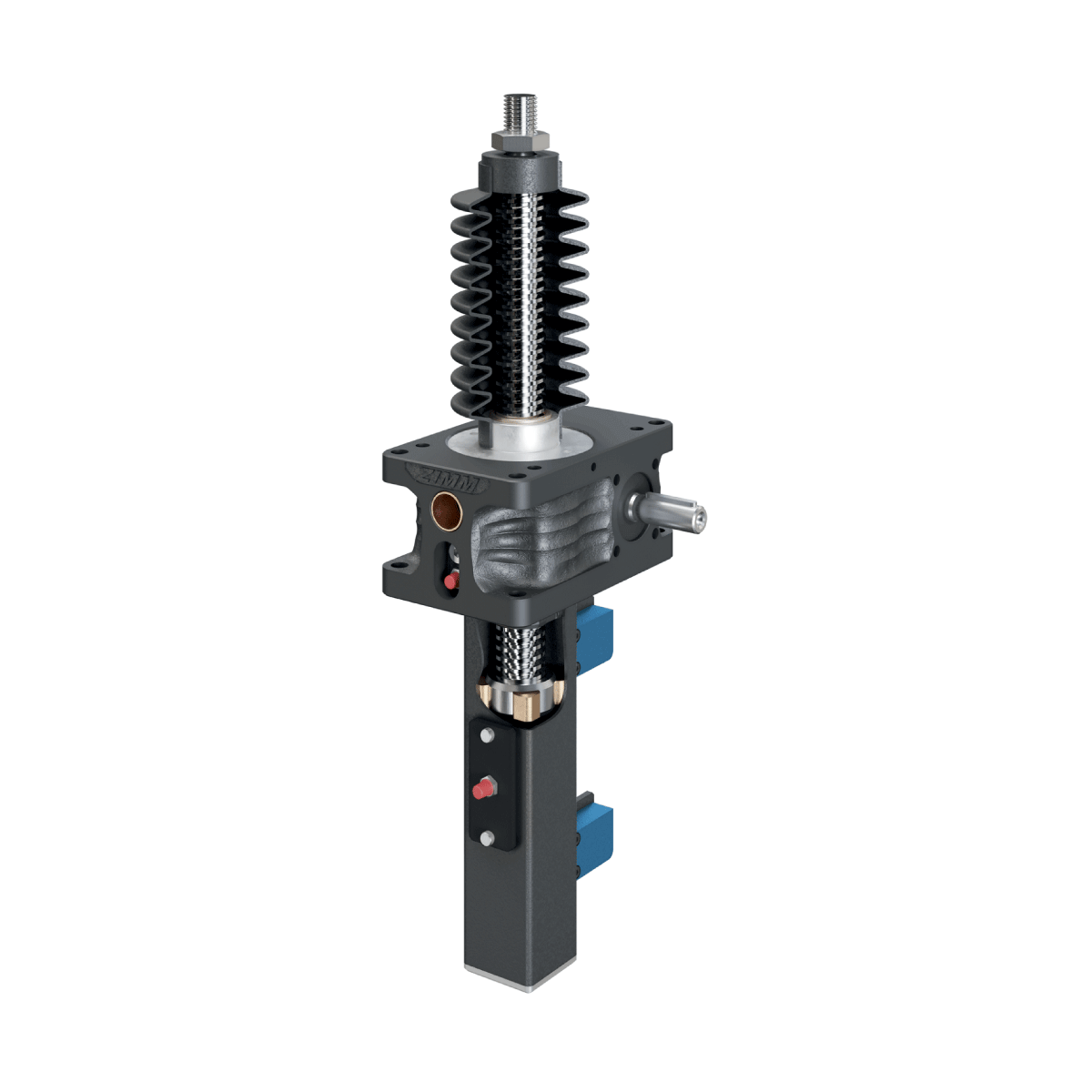
In ground support equipment (GSE), electromechanical drive systems perform numerous lifting, adjusting, levelling and drive tasks; in the standards, these vehicles and units are also referred to as aircraft ground equipment. ZIMM electromechanical actuators and screw jacks generate the linear movements, ZIMM ZK bevel gearboxes distribute the rotary motion of one motor to several outputs.
Within the ZIMM modular system, screw jacks and electromechanical actuators can be combined with screws, motors, connecting shafts, couplings and add-on parts. The result is not a single component but a complete drive system matched to the particular movement task. ZIMM supplies the drive components and provides support with selection and sizing; the overall installation is designed by the respective vehicle or plant manufacturer. The information required for sizing is listed in the frequently asked questions.
ZIMM GmbH develops and manufactures screw jacks, bevel gearboxes, electromechanical actuators and matching add-on parts for industrial lifting, positioning and drive tasks at Millenniumpark 3, 6890 Lustenau, Austria.
Electromechanical actuators
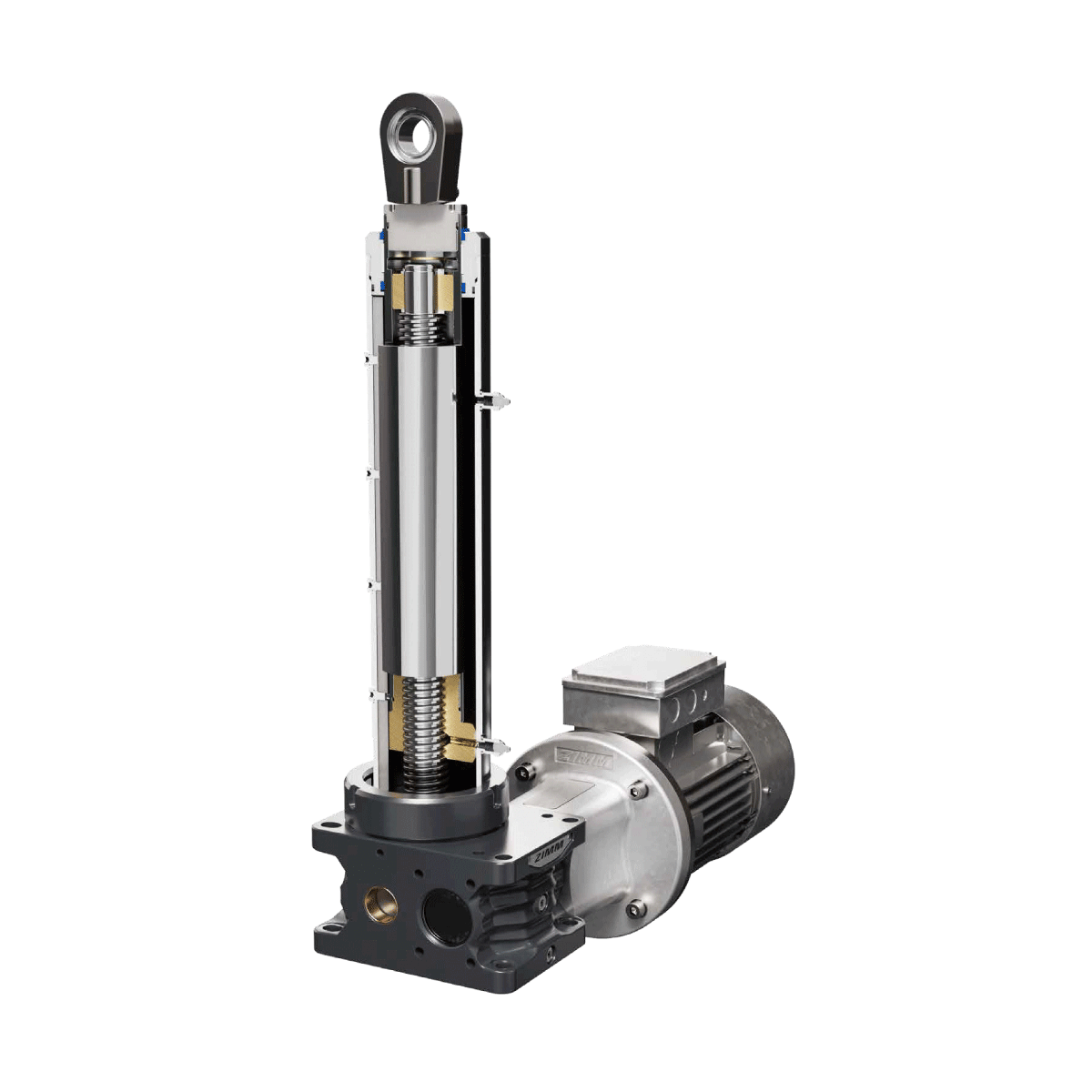
ZIMM electromechanical actuators generate controlled linear movements for lifting, lowering, supporting, positioning and adjusting components or loads. Depending on the version and the system design, they are available for lifting forces from 25 to 200 kN.
The screw enclosed in the housing and the sealed gear support use in demanding environments. Degree of protection, corrosion protection, temperature range, lubrication and sealing design are defined according to the actual operating and ambient conditions. Matching flanges, rod ends, support plates, bearings, limit switches and further add-on parts support both mechanical integration and integration into the control system.
Several actuators can be moved together in two ways. A mechanical coupling via connecting shafts enforces the same stroke at all coupled drive points, provided the ratio and the screw lead are identical; the synchronisation is therefore defined kinematically and does not depend on the control system. Where drive points are driven separately, different strokes are possible; in this case the synchronisation is established by the control system and position sensors and has to be monitored. Both variants can be combined within one installation.
ZK Bevel gearboxes
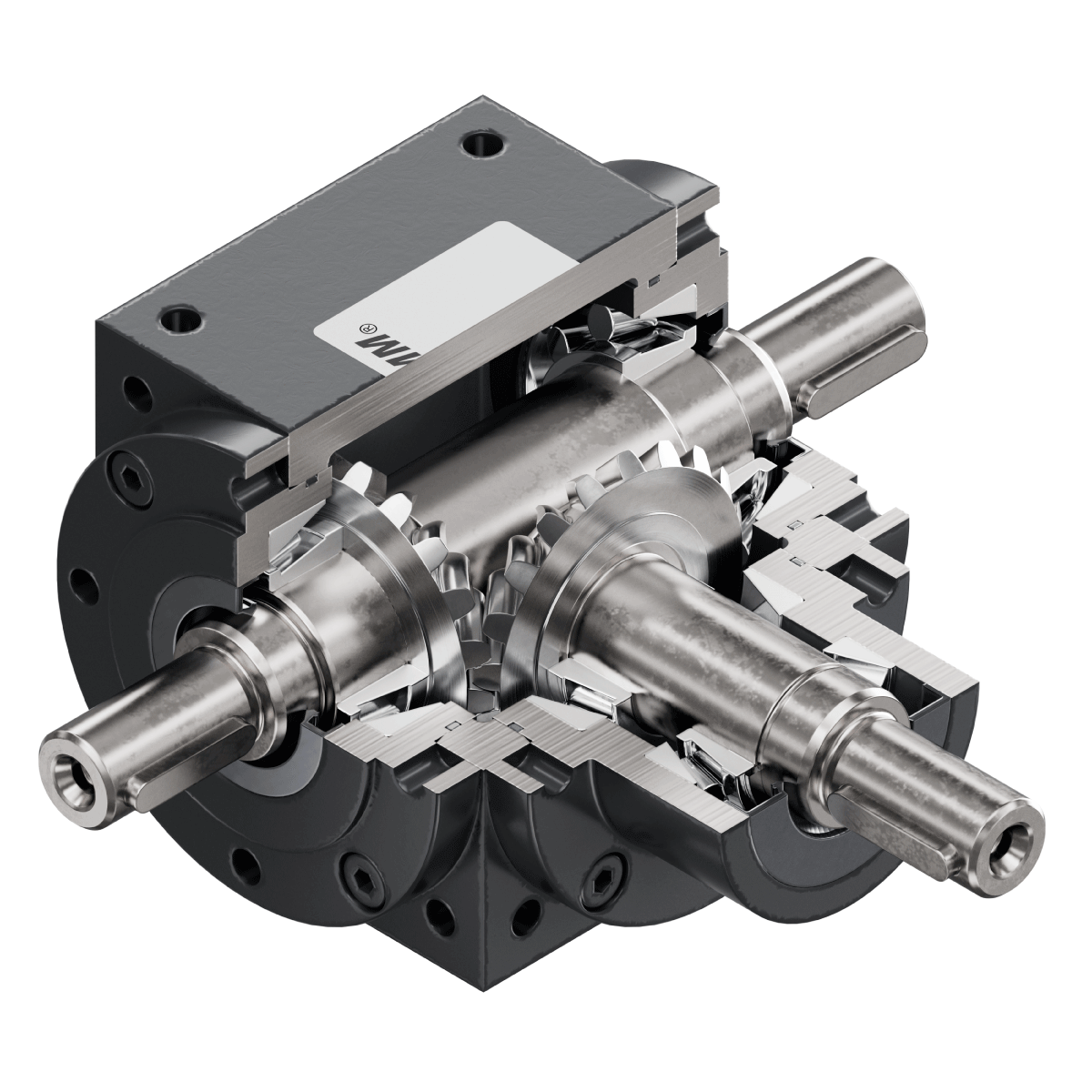
ZIMM ZK bevel gearboxes redirect an input rotary motion through 90° and transmit the torque to one or two output shafts. Four sizes are available with output torques from 18 to 200 Nm and the ratios 1:1, 2:1 and 3:1.
Size and ratio are selected on the basis of the required output torque, the input speed, the axial and radial forces at the shafts, the mounting orientation and the operating mode. Type and version result from the number and the position of the required output shafts and from the type of shaft connection. The types 1.1, 1.2 and 1.3 and the versions WE-FN and HW-FN are available.
Matching add-on parts are available for ZK bevel gearboxes: connecting shafts VWZ, pedestal bearings STL, shaft extensions WZ, couplings KUZ and three-phase AC motors. Integration into the overall system, the alignment and support of the shafts and the higher-level safety concept are defined within the respective system.
Certification, standards and project-specific verification
ZIMM screw jacks, electromechanical actuators and ZK bevel gearboxes are industrial components. The quality management system of ZIMM GmbH is certified to ISO 9001:2015. In ground support equipment, international standards and industry standards additionally set requirements for the complete vehicle or unit, including:
- International (ISO): ISO 6966-1 and ISO 6966-2 – basic requirements for aircraft ground equipment (general design requirements, safety requirements). ISO 4116 – requirements for conveying surfaces for unit load devices. ISO 12056, ISO 6967 and ISO 6968 – functional requirements for self-propelled passenger stairs, main deck loaders and lower deck loaders.
- Europe (EN): EN 1915-1 and EN 1915-2 – general requirements (basic safety requirements; stability and strength requirements, calculations and test methods). EN 12312-1, EN 12312-9 and EN 12312-10 – specific requirements for passenger stairs, container/pallet loaders and container/pallet transfer transporters.
- SAE International: SAE ARP1247 – general requirements for aircraft ground support equipment. SAE ARP836 – design and safety criteria for passenger stairs.
- IATA Airport Handling Manual: AHM 910 and AHM 913 – basic requirements and basic safety requirements. AHM 931 and AHM 932 – functional specifications for lower deck and main deck loaders.
Verification to these standards is not part of the standard version. Requirements arising from them are assessed within the project business and the version is developed accordingly. Scope of testing, verification, the required documentation and responsibilities are defined for each project. Conformity of the complete vehicle or unit is verified by its manufacturer. Which standards are applicable depends on the country of use, the operator and the specification; the scope is therefore agreed together with the vehicle or equipment manufacturer. Requirements regarding ambient conditions, degree of protection, corrosion protection and documentation should be incorporated into the sizing as early as possible, as they influence the series, the version and the add-on parts.
Selected applications in ground support equipment
Passenger steps | Adjusting the stair height to the aircraft door
Passenger steps connect the apron with the aircraft door and have to be adjusted to the door sill height of the respective aircraft type. In the standards they are referred to as passenger stairs. The linear lifting movement is generated by two ZIMM electromechanical actuators. The two actuators are arranged parallel between the chassis and the pivoting stairway, one on each side of the vehicle. One motor drives the first actuator directly and the second via a connecting shaft, so that both cover the same stroke. The vehicle control system specifies the stair height and evaluates the end position and position signals. In technically suitable applications, the electromechanical height adjustment can replace hydraulic lifting drives. Stairway, chassis, guidance, locking, sensors and stability are designed within the vehicle and the overall system.
Benefits
- Height adjustment of the stairway at two defined linkage points
- Joint drive of both actuators by one motor and one connecting shaft
- Reproducible stair height for different aircraft types
- No hydraulic drive medium within the ZIMM lifting axes
- Adaptation to stairway mass, stroke and existing linkage points
Operating principle
- Two electromechanical actuators generate the linear lifting movement
- A connecting shaft transmits the rotary motion of the motor to the second actuator
- The actuators act at the linkage points of the stairway provided for in its design
- The vehicle control system coordinates the lifting movement up to the required door sill height
- Guiding, locking and safety elements secure the stairway at the set height
Application scenarios
- Self-propelled passenger steps
- Passenger steps with two mechanically coupled actuators
- Passenger steps for wide-body aircraft
- Passenger steps for aircraft types with different door sill heights
- Replacement of technically suitable hydraulic lifting drives by electromechanical solutions
The vehicle is brought into a defined working position on four lifting posts. The ZIMM actuators are combined into a front and a rear lifting group, and the control system coordinates both groups.
Loader | Adjusting the platform height and driving the turntable
A loader takes over containers and pallets at the cargo door and for this purpose has to be adjusted to the cargo door height of the respective aircraft type. In the standards it is referred to as a container/pallet loader. The linear lifting movement is generated by two ZIMM electromechanical actuators. The two actuators are arranged at an angle between the chassis and the scissor arm of the platform, one on each side of the vehicle. One motor drives the first actuator directly and the second via a connecting shaft, so that both cover the same stroke. The vehicle control system specifies the platform height and evaluates the end position and position signals. In the turntable of the platform, one motor per roller train drives four roller segments via ZIMM ZK bevel gearboxes, connecting shafts and couplings. Platform, scissor mechanism, guidance, locking, sensors and stability are designed within the vehicle and the overall system.
Benefits
- Height adjustment of the platform at two defined linkage points
- Joint drive of both actuators by one motor and one connecting shaft
- Drive of four roller segments per roller train by one motor
- No hydraulic drive medium within the ZIMM lifting axes
- Adaptation to platform mass, stroke and existing linkage points
Operating principle
- Two electromechanical actuators generate the linear lifting movement
- A connecting shaft transmits the rotary motion of the motor to the second actuator
- One motor per roller train drives four roller segments via ZK bevel gearboxes, connecting shafts and couplings
- The vehicle control system coordinates the lifting movement up to the required cargo door height
- Guiding, locking and safety elements secure the platform at the set height
Application scenarios
- Loaders for lower deck cargo holds
- Loaders for main deck cargo holds
- Loaders with a turntable on the platform
- Loaders for aircraft types with different cargo door heights
- Replacement of technically suitable hydraulic lifting drives by electromechanical solutions
Luftfracht-Loader: Plattform heben und Drehfeld antreiben
Transporter | Driving the roller deck with turntable
A transporter takes over containers and pallets from the loader and has to convey them onto its roller deck via driven rollers. In the standards it is referred to as a container/pallet transfer transporter. The rotary motion is deflected through 90° by ZIMM ZK bevel gearboxes and transmitted to the roller segments. In the version with turntable, the roller segments are arranged in two roller trains. One motor per roller train drives four roller segments via ZIMM ZK bevel gearboxes, connecting shafts and couplings. The two motors are controlled by the vehicle control system. The eight ZK bevel gearboxes of the turntable are complemented by six VWZ connecting shafts, eight KUZ couplings and two motors with motor flange from the ZIMM modular system. Roller segments, roller deck, guidance, locking, sensors and securing of the unit load device are designed within the vehicle and the overall system.
Benefits
- 90° deflection and torque transmission at each roller segment
- Joint drive of four roller segments by one motor
- Synchronisation of the four roller segments of one roller train via connecting shafts
- ZK bevel gearboxes with an efficiency of 0.97 and low backlash
- Adaptation to the number of roller segments, output torque and speed
Operating principle
- One motor per roller train applies the rotary motion to the first ZK bevel gearbox via a motor flange
- Three VWZ connecting shafts connect the four ZK bevel gearboxes of one roller train
- Each ZK bevel gearbox deflects the rotary motion through 90° and transmits it to one roller segment via a KUZ coupling
- The vehicle control system coordinates the movement of the two roller trains
- Guiding, locking and safety elements secure the unit load device on the roller deck
Application scenarios
- Self-propelled transporters for containers and pallets
- Roller drives with one motor for several roller segments
- Roller decks with turntable
- Transfer of unit load devices from the loader onto the roller deck
- Replacement of technically suitable hydraulic roller drives by electromechanical solutions
Adjusting the reflector calls for high actuating forces at low speeds, with long periods in a held position. The mechanical ratio of a ZIMM screw jack suits this profile.
Frequently asked questions about ZIMM drive technology for ground support equipment
Send your enquiry about your ground support equipment application now
Are you planning a lifting, adjusting, levelling or drive task in ground support equipment? Describe your application and send us the details you already have on load or torque, stroke, speed, duty cycle, number of drive points, installation situation and ambient conditions. A drawing or sketch can be attached directly. Our application engineers will support you in selecting suitable electromechanical actuators, screw jacks, ZK bevel gearboxes and matching system components – including project-specific special applications.