

YOUR REQUIREMENTS – OUR SOLUTIONS
ZIMM drive technology for defence | Lifting, levelling and positioning
| Movement tasks: | Lifting · Supporting · Levelling · Erecting · Positioning |
| Product groups: | Screw jacks · Electromechanical actuators |
| Lifting force ranges: | Screw jacks: 2.5 to 1,000 kN per gearbox · Electromechanical actuators: 25 to 200 kN |
| Application examples: | Four-post lifts for military vehicles · Vehicle levelling with antenna erection · Antenna positioning in fixed installations |
| Areas of use: | Military vehicles · Workshops · Radar and communication systems · Antenna installations · Mobile platforms · Shelters · Special vehicles |
| Quality management: | ISO 9001:2015 · Requirements from military standards on a project-specific basis |
In the defence sector, linear drive systems perform numerous lifting, adjusting, levelling and positioning tasks. ZIMM screw jacks and electromechanical actuators generate these movements and can be adapted to different system requirements.
Within the ZIMM modular system, screw jacks and electromechanical actuators can be combined with screws, motors, connecting shafts, couplings and add-on parts. The result is not a single component but a complete drive system matched to the particular movement task. ZIMM supplies the drive components and provides support with selection and sizing; the overall installation is designed by the respective vehicle or plant manufacturer. The information required for sizing is listed in the frequently asked questions.
ZIMM GmbH develops and manufactures screw jacks, bevel gearboxes, electromechanical actuators and matching add-on parts for industrial lifting, positioning and drive tasks at Millenniumpark 3, 6890 Lustenau, Austria.
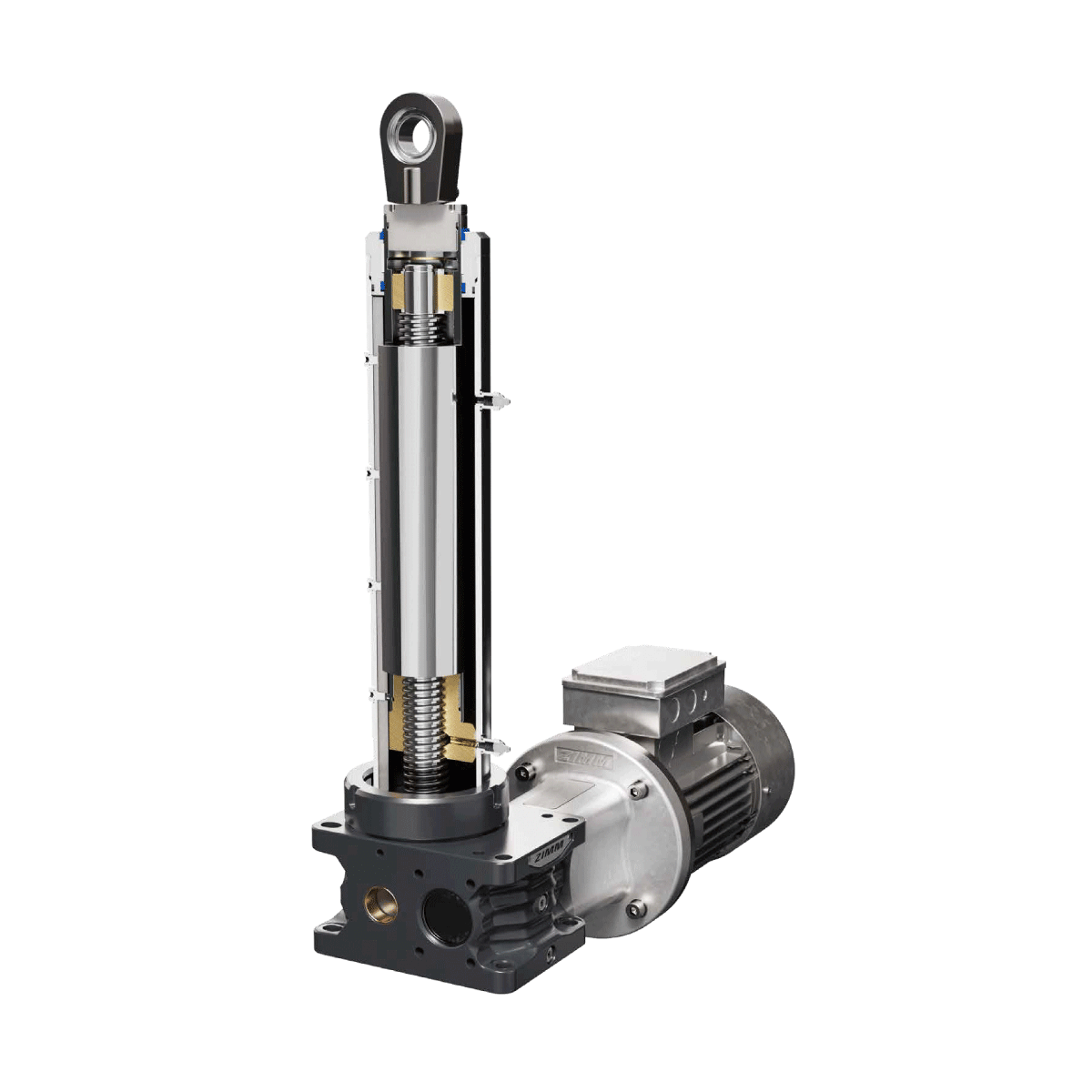
Electromechanical actuators
ZIMM electromechanical actuators generate controlled linear movements for lifting, lowering, supporting, positioning and adjusting components or loads. Depending on the version and the system design, they are available for lifting forces from 25 to 200 kN.
The screw enclosed in the housing and the sealed gear support use in demanding environments. Degree of protection, corrosion protection, temperature range, lubrication and sealing design are defined according to the actual operating and ambient conditions. Matching flanges, rod ends, support plates, bearings, limit switches and further add-on parts support both mechanical integration and integration into the control system.
Several actuators can be moved together in two ways. A mechanical coupling via connecting shafts enforces the same stroke at all coupled drive points, provided the ratio and the screw lead are identical; the synchronisation is therefore defined kinematically and does not depend on the control system. Where drive points are driven separately, different strokes are possible; in this case the synchronisation is established by the control system and position sensors and has to be monitored. Both variants can be combined within one installation.
Certification, standards and project-specific verification
ZIMM screw jacks and electromechanical actuators are industrial components. The quality management system of ZIMM GmbH is certified to ISO 9001:2015. In the defence sector, verification to military standards is frequently required in addition, including:
- MIL-STD-810 – behaviour under environmental conditions such as temperature, humidity, dust, shock and vibration
- MIL-STD-461 – electromagnetic compatibility
This verification is not part of the standard version. Requirements from military standards are assessed within the project business and the version is developed accordingly. Scope of testing, verification, the required documentation and responsibilities are defined for each project. For electromagnetic compatibility, verification generally covers the overall system including motor, cables and control system. The scope is therefore agreed together with the party responsible for the system. Requirements regarding ambient conditions, degree of protection, corrosion protection and documentation should be incorporated into the sizing as early as possible, as they influence the series, the version and the add-on parts.
Selected applications in defence technology
Electromechanical four-post lifting system | Raising military vehicles under control
For assembly, inspection and maintenance work, military vehicles can be raised on four lifting posts and brought into a defined working position. The lifting posts represent the four functional pick-up points. The linear lifting movements are generated by four ZIMM electromechanical actuators. Two actuators are located at the front and two at the rear of the vehicle. The two front actuators and the two rear actuators are each controlled together as a lifting group. The control system coordinates the movement of the front and rear lifting groups throughout the entire lifting operation. In technically suitable applications, the electromechanical four-post lifting system can replace hydraulic lifting concepts. Vehicle pick-up, supporting structure, guidance, locking, sensors and safety functions are designed to suit the vehicle and workshop application.
Benefits
- Vehicle lifting at four defined pick-up points
- Joint control of the front and rear actuator pairs
- Reproducible working height for assembly and maintenance
- No hydraulic drive medium within the ZIMM lifting axes
- Adaptation to vehicle mass, stroke and existing pick-up points
Operating principle
- Four electromechanical actuators generate the linear lifting movements
- Two actuators each form a jointly controlled front or rear lifting group
- The four lifting posts take up the vehicle at the points provided for in its design
- The control system coordinates the movement of the two lifting groups up to the required working height
- Supporting, guiding, locking and safety elements secure the vehicle in the working position
Application scenarios
- Assembly and maintenance work on military vehicles
- Inspections of the vehicle underside and running gear
- Replacement and servicing of vehicle components
- Stationary lifting systems in workshops and depots
- Replacement of technically suitable hydraulic lifting systems by electromechanical solutions
The vehicle is brought into a defined working position on four lifting posts. The ZIMM actuators are combined into a front and a rear lifting group, and the control system coordinates both groups.
Levelling a military vehicle and erecting a radar | Two electromechanical adjusting functions
On uneven ground, mobile radar and vehicle systems first have to be brought into a defined horizontal position. Four ZIMM electromechanical actuators perform the linear adjusting movements at the support points of the vehicle. Two actuators are arranged at the front and two at the rear of the vehicle. Coordinated control of the four actuators compensates for differences in ground height and brings the vehicle into the intended operating position. After levelling, separate electromechanical actuators move the radar mounted on the vehicle from the transport position into the operating position. Vehicle levelling and radar erection are therefore two technically separate adjusting functions that follow one another within the same application. Ground pads, support structure, locking, sensors and stability are designed within the vehicle and the overall system.
Benefits
- Levelling of the vehicle on uneven ground
- Adjustment of the vehicle attitude via four support points
- Defined starting position for operation of the radar system
- Electromechanical erection and lowering of the radar
- Integration of both adjusting functions into the higher-level vehicle control system
Operating principle
- The sensors detect the current inclination or attitude of the vehicle
- Four electromechanical actuators change the height at the support points
- The control system coordinates the travel until the defined horizontal vehicle position is reached
- Separate electromechanical actuators then move the radar into the operating position
- Ground pads, supporting structure, locking and safety functions secure the vehicle and radar during operation
Application scenarios
- Mobile radar platforms
- Communication and command vehicles
- Mobile reconnaissance and surveillance systems
- Vehicles with erectable technical systems
- Mobile platforms with a defined horizontal operating position
Four ZIMM actuators compensate for uneven ground at the support points and bring the vehicle into a horizontal attitude. Only then is the radar moved into the operating position.
Antenna positioning | Setting the elevation angle of the reflector
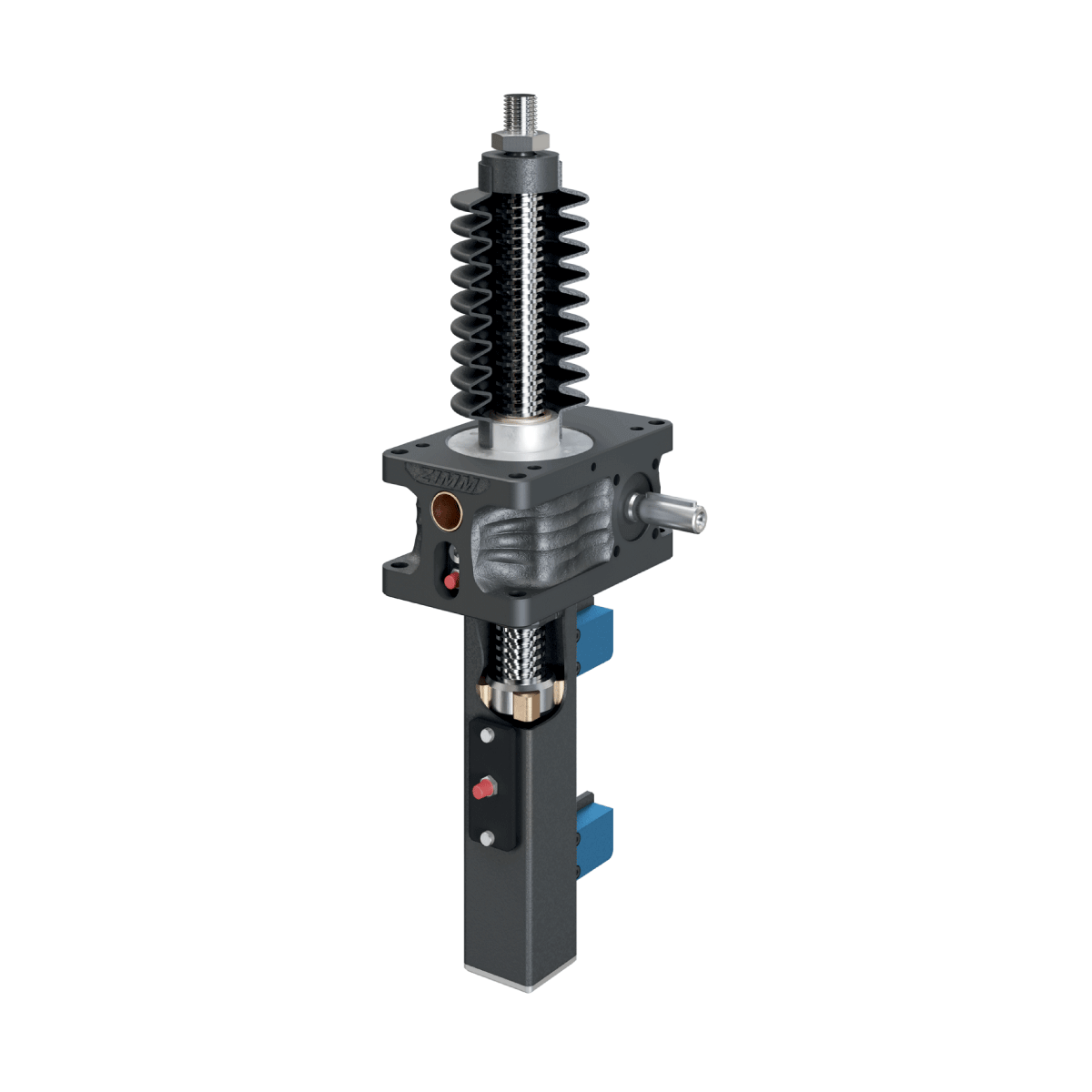
In stationary antenna and radar systems, the reflector has to be moved to the required elevation angle and positioned reproducibly. A ZIMM screw jack generates the linear adjusting movement required for this. Via a linkage point defined in the design, the linear movement is converted into a pivoting movement of the antenna reflector. This application is characterised by low adjusting speeds, fine adjustment steps and long periods in a held position. The actuating force has to be sized so that the forces acting at the linkage point from dead weight and wind load are absorbed. Series and size are selected according to reflector mass, lever ratios, the wind load to be applied, adjustment range, adjusting speed, positioning requirement and duty cycle.
Benefits
- Defined setting of the elevation angle
- Reproducible positioning of the antenna reflector
- High actuating forces thanks to the mechanical ratio
- Integration into an application-specific supporting and pivoting structure
- Adaptation to reflector mass, lever ratios and angular range
Operating principle
- A motor applies a rotary motion to the screw jack
- The screw jack converts the rotary motion into a linear adjusting movement
- The linear movement acts on the reflector structure via a defined linkage point
- The antenna reflector is moved to the required elevation angle
- Suitable position monitoring reports the position reached to the higher-level control system
Application scenarios
- Stationary parabolic antennas
- Radar and communication installations
- Ground stations with an adjustable antenna reflector
- Antenna systems with a variable elevation angle
- Retrofitting of existing mechanical positioning systems
Adjusting the reflector calls for high actuating forces at low speeds, with long periods in a held position. The mechanical ratio of a ZIMM screw jack suits this profile.
Frequently asked questions about ZIMM drive technology for defence applications
Send your enquiry about your defence application now
Are you planning a lifting, adjusting, levelling or positioning task in the defence sector? Describe your application and send us the details you already have on load, stroke, speed, duty cycle, number of drive points, installation situation and ambient conditions. A drawing or sketch can be attached directly. Our application engineers will support you in selecting suitable screw jacks, electromechanical actuators and matching system components – including project-specific special applications.